
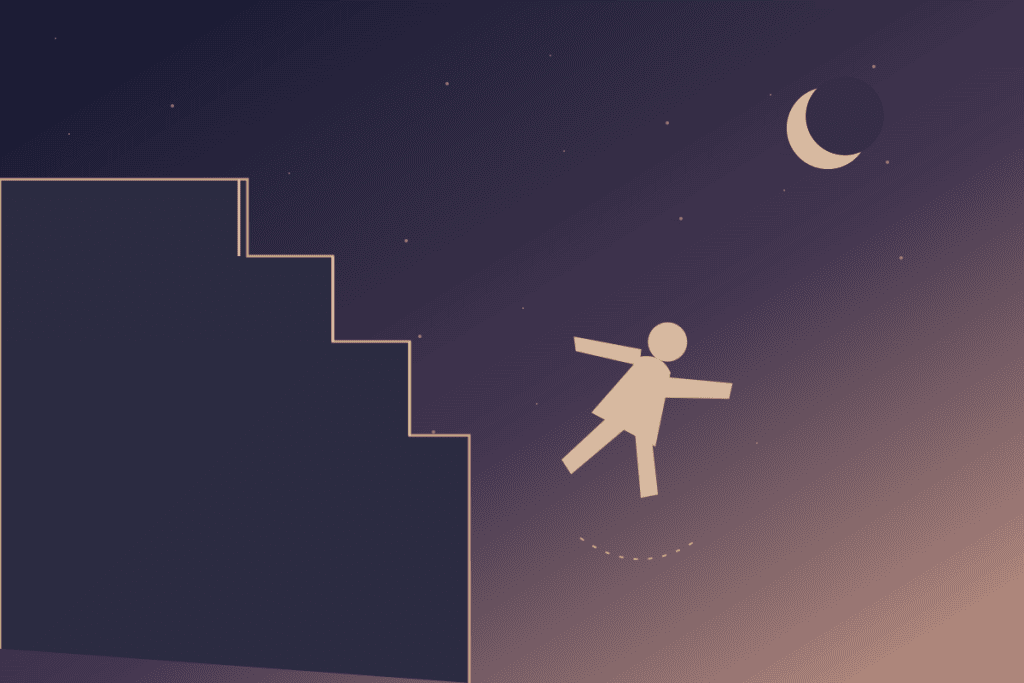
A falling dream is easier to explore when you identify what actually happened: a long drop with a setting and a story, or a split-second sensation as you drifted off. Neither experience predicts an accident. A dream about losing your footing might suggest a useful comparison with uncertainty, but it does not prove you are losing control of your life. Start with the scene rather than a verdict about yourself.
A dream of falling or a sleep start?
Sleep-onset jerks can include a falling sensation (2). That is relevant if your strongest memory is a quick jolt as you began sleeping. It does not explain every falling dream. A remembered story about a rooftop, a staircase and another person gives you different material to consider. Waking frightened is not enough to diagnose the cause of an episode.
Memories can enter dreams (1). Think about a climbing wall, a film or a steep flight of stairs you encountered recently. Recognising a familiar image does not prevent a personal interpretation, but it keeps you from assuming the scene must reveal a hidden problem.
Where did you lose your footing?
Missing a stair may lead you to think about pace: were you hurrying to keep up, carrying too much, or looking elsewhere? Falling from a balcony brings different details into view, including whether a barrier was present and whether you approached the edge willingly. Do not assign a career meaning to a staircase just because it goes upwards.
If someone pushes you, note the shift from accident to interference. You might explore feeling pressured if that fits your waking circumstances. The dream does not establish that the person represented would harm you. If the cause is missing, write “I do not know how the fall started” rather than filling the gap with a culprit.
Fear is not the only possible feeling
A peaceful descent, an exhilarating drop and a terrifying fall are different experiences. Ask whether you resisted, accepted the movement or discovered an unexpected way to slow down. A connection with freedom may fit one account; uncertainty may fit another. Neither is a universal explanation.
Watching somebody else fall also changes your position. Are you trying to reach them, calling for help or unable to move? That may prompt a question about support or responsibility, if relevant to you. It is not a warning about that person’s safety. Keep the dreamed character separate from what you know about the actual person.
What happens at the end?
Waking before impact leaves the ending unknown. It does not establish that the dream would have ended in death. Landing safely, finding a handrail or being caught gives the story an outcome worth recording instead of remembering only the frightening beginning.
Falling into a lake adds a new situation: can you swim, breathe or reach the shore? Compare the details with water dreams. If the fall turns into gliding, flying dreams may be the more useful comparison. The change matters more than attaching several meanings to the same image.
Make a note you can actually use
Imagine, as a fictional example, someone missing a stair while carrying a stack of folders. They initially call it a dream about failure. On reflection, the memorable problem was having no free hand for the rail. A question about practical support might suit that account better. This is an example of personal reflection, not evidence that folders or rails have fixed meanings.
Write down the setting, the action immediately before the drop and the ending you remember. Add the feeling that remained once you were fully awake. If repeated movements interrupt sleep or concern you, seek medical advice rather than relying on symbolic interpretation (2). A clinician can consider what you observe without needing you to identify the cause yourself.
Does falling in a dream mean bad luck?
The dream provides no basis for predicting bad luck, death or a coming setback. You can explore its emotional resonance while leaving the future out of the explanation. If no personal association fits, there is no need to manufacture one.
Sources
(1) Vallat et al. (2017), Characteristics of the memory sources of dreamshttps://journals.plos.org/plosone/article?id=10.1371/journal.pone.0185262
(2) Cleveland Clinic — Why Do I Feel Like I’m Falling or Twitching As I’m Falling Asleep?https://health.clevelandclinic.org/why-do-i-feel-like-im-falling-when-im-falling-asleep-video
Personal symbolic readings; the cited studies do not validate universal meanings.
Further reading
 Blood dream meaning: bleeding, stained hands and injured people
 Flying dream meaning: taking off, gliding, height and landing
 03:33 Meaning: Love, Angel Number 333 and Waking at Night
 Burglary dream meaning: intruders, a searched home and missing things
 Dreaming about your ex: reunion, rejection and recurring dreams
 Dreaming about a wedding: getting married, missed vows and cancellations
 Car accident dream meaning: driver, passenger, witness and escape
 Flood dream meaning: rising water, flooded homes and finding safety