
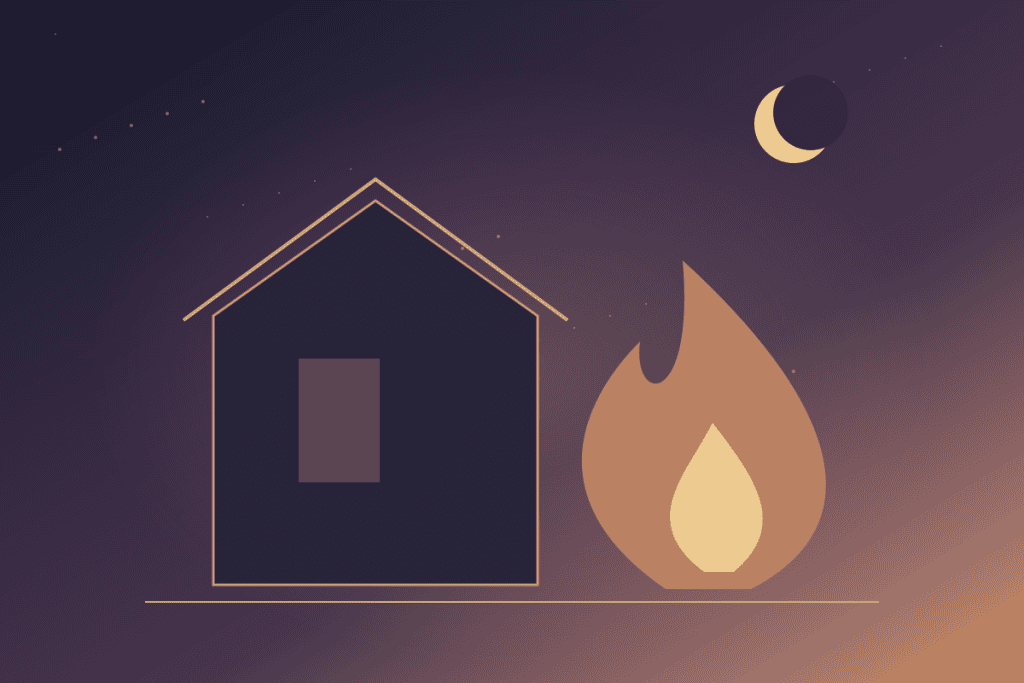
A fire dream can bring up threat, intensity or changes that feel difficult to contain. A controlled flame may suggest warmth or shared comfort instead. These are possible associations, not fixed meanings. Start with the fire you actually experienced rather than assuming every flame represents anger or renewal.
Dreams can include memories (1). A news report, a film, a cooking incident or an earlier experience may have provided the image. A vivid dream does not establish that a fire will happen.
Contained heat or spreading danger?
A candle and an engulfed building create different scenes. Notice when the boundary changes: a curtain catches, smoke obscures a doorway or a small flame spreads. If you see a connection with waking life, identify one concrete situation that felt manageable and then became harder to handle.
You may find no connection at all. That is a valid outcome. The dream does not require you to discover a crisis that you had not previously recognised.
The house matters, but it is not a code
Your current home may bring up daily stability and belongings. A childhood home may recall another period. An unfamiliar building may make not knowing the exits the central problem. None automatically represents your mind, body or family.
What do you try to protect? Finding a pet, looking for documents and reaching a door give different priorities to the story. The order of imagined actions is not a ranking of how much you love real people.
Watching, escaping and being unable to act
Watching from a distance may involve relief, curiosity or helplessness. Being frozen in a dream does not establish how you would behave in an emergency. Running outside is not evidence of cowardice. Describe what you wanted to do and what prevented it.
If someone remains inside, the scene may leave guilt on waking. That feeling is real, but the dream does not make you responsible for an actual injury. Separate the emotional aftermath from a claim about your conduct.
Putting out the flames or receiving help
Trying to extinguish a fire can offer a metaphor for containing a difficulty. Ask whether the attempt works and whether someone helps. Finding a new tool or accepting assistance changes the scene; it should not disappear from your account because the flames were memorable.
For an invented example, picture a dream in which you keep searching for a phone while a neighbour has already called for help. The question might be whether you noticed support, rather than whether you must solve everything yourself. It is a reflective example, not advice about a real fire.
Smoke, colour and the scene after the fire
Smoke may make uncertainty more important than damage. Bright flames without heat may feel strangely beautiful. Black smoke does not predict bad news, and a particular flame colour cannot certify protection. Ask what was visible and what changed your feelings.
The ending matters: an intact room, a place to shelter, ash or people reunited. A destructive scene does not have to be called beneficial transformation. You can use renewal as a personal metaphor if it helps without insisting that frightening loss was necessary.
If the home is overwhelmed by a different force, compare flood dreams. If the scene centres on a sudden interruption, see car accident dreams. These are comparisons, not symbols to add into a prediction.
Is it a warning?
The dream is not a reliable safety assessment. Actual concerns about a building require real observations and appropriate safety information. For the feeling that the dream predicts something, read precognitive dreams.
What if I experienced a real fire?
You may recognise a personal memory without finding a hidden lesson. Seek support if nightmares repeatedly affect sleep and everyday life (2). You do not need to decode the image before discussing its impact.
Sources
(1) Vallat et al. (2017), Characteristics of the memory sources of dreamshttps://journals.plos.org/plosone/article?id=10.1371/journal.pone.0185262
(2) NHS, Night terrors and nightmareshttps://www.nhs.uk/conditions/night-terrors/
Personal symbolic readings; the cited studies do not validate universal meanings.
Further reading
 Flood dream meaning: rising water, flooded homes and finding safety
 Dreaming of spiders: bites, webs, giant spiders and what to notice
 Dreaming about a wedding: getting married, missed vows and cancellations
 04:40 meaning: reliability without rigid control
 Dreaming of rats: bites, infestations, dead rats and pets
 22:20 Meaning: Love, Twin Flames, Angel Number and Numerology
 11:11 meaning: symbolism, wishes and what the clock cannot tell you
 1155 Angel Number Meaning: Love, Twin Flames & Change