
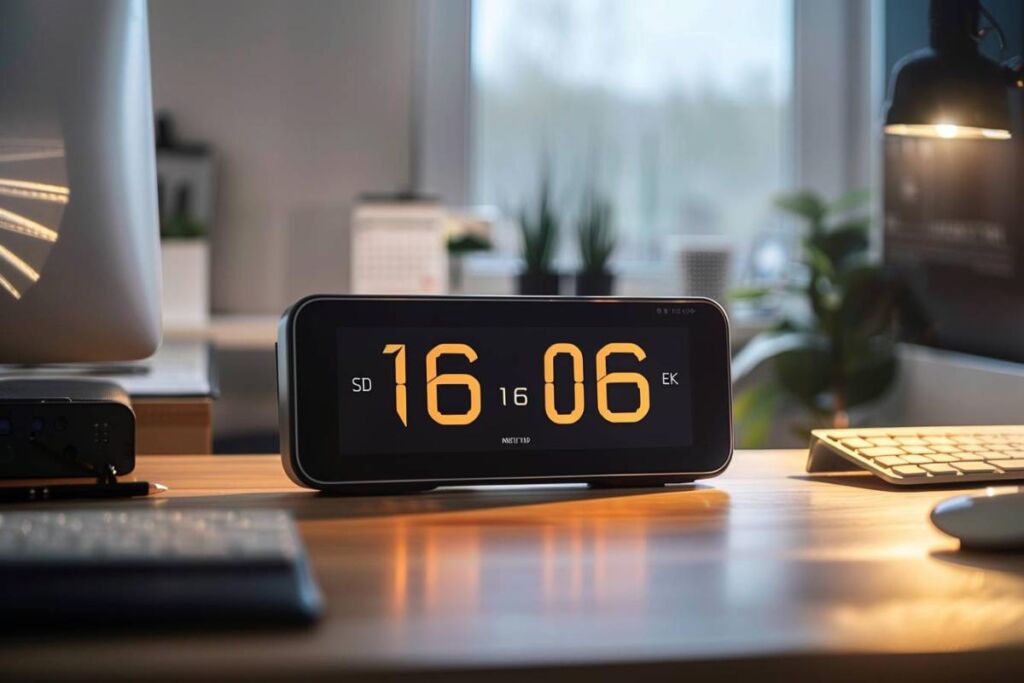
16:06, shown as 4:06 p.m. on a 12-hour clock, can be read as a prompt to make your responsibilities more sustainable. That is a symbolic interpretation, not a prediction delivered by the clock. The useful question is whether the way you are holding things together still leaves room for your own needs.
You might notice this time while finishing a task, waiting for a reply or deciding whether to say yes to another request. The circumstances matter more than a supposedly universal message. A careful reading starts with what is actually happening, then uses the numbers to explore it without handing them the decision.
Is 16:06 really a mirror hour?
Strictly speaking, it is neither a double hour nor a reversed hour. The two sides are not identical, as in 16:16, and 06 is not 16 written backwards. It is also not a triple hour: only the 6 occurs twice. Here, “mirror hour” is being used in the broader sense of a clock time that attracts attention and invites interpretation.
This distinction helps when comparing meanings. 16:16 has a repeating structure that 16:06 does not. Their proximity on the clock does not make them interchangeable. Nor is 4:06 a.m. the same time: in 24-hour notation that would be 04:06.
The numerology of 16:06, with the method made explicit
A common digit-reduction method gives 1 + 6 + 0 + 6 = 13, then 1 + 3 = 4. In contemporary numerological symbolism, 4 often represents foundations, organisation and consistency. The repeated 6 is often associated with care, domestic life and responsibility; 1 suggests initiative. These are interpretive conventions, not measurable forces.
Read together, they offer a useful tension: wanting to help is different from having a workable system for helping. You may be committed to a relationship or project yet relying on last-minute effort to keep it going. The reading points towards a structure that can support your intentions.
Notice that reducing the visible digits of 4:06 gives 4 + 0 + 6 = 10, then 1. That is a different calculation. This article uses 16:06, the 24-hour form. Neither system establishes an objective truth, but switching between them without saying so creates misleading explanations.
When being dependable starts to cost too much
One possible spiritual reading concerns responsibility without self-erasure. Being the person others rely on can be meaningful. It becomes less healthy as an arrangement when every request is treated as yours to solve and no one checks whether you have the time.
Imagine a colleague who routinely asks you to finish their work. You can acknowledge the pressure they face and still ask which task your manager wants postponed. The change is not a grand rejection of generosity. It is making the real cost visible.
If 16:06 catches your eye in such a moment, ask: What am I maintaining through effort that would work better through an agreement? A clear deadline, division of labour or limit may answer that question more effectively than another promise to cope.
What 4:06 p.m. might mean in love
For an established relationship
The repeated 6 can provide a starting point for discussing how care is expressed. One partner may show love through practical help, while the other wants unhurried attention. Neither preference makes a person unloving; trouble begins when each assumes their own effort is the only form that counts.
Choose one concrete example instead of saying “you never appreciate me.” You might explain that planning every weekend has become tiring, then ask your partner to arrange the next one. Look for a response and a change in behaviour. The time itself cannot tell you whether a relationship is mutual.
If you are single or thinking about someone
16:06 does not prove that a person misses you or that a meeting is imminent. A more useful interpretation concerns what kind of connection you are making room for. Do you want reliability, shared interests, more independence? Naming that preference helps you evaluate an actual encounter without building a story around a repeated number.
The same boundary applies to twin-flame interpretations. An intense feeling can deserve reflection, but a clock pattern cannot establish another person’s consent, intentions or compatibility.
Work, money and the value of a solid foundation
The symbolism of 4 favours something you can inspect: a realistic schedule, a clear brief, a completed application or a written record of commitments. If you are tempted to treat 16:06 as encouragement to take a leap, first define what would make that leap manageable.
For example, someone considering a different role might list the skills the vacancy actually requires and identify one gap they can address. That is more informative than assuming the time guarantees success. Similarly, no hour predicts income, investment returns or a financial windfall. Decisions involving money need real figures and conditions.
A short reflection you can use today
Write down the request, task or relationship that was on your mind when you saw the time. Beside it, finish this sentence: “The part I can reasonably take responsibility for is…” Then name what belongs to someone else or remains outside your control.
Choose one small adjustment that follows from those words. You might ask for a missing detail, stop offering a deadline you cannot meet or reserve time to finish your own work. Keep the action proportionate. You do not need to reorganise your life because a display caught your attention.
Questions about seeing 16:06 repeatedly
Does it mean an angel is contacting me?
Some spiritual traditions interpret repeated clock sightings as angelic guidance. You may use that belief as a personal source of encouragement, but there is no reliable way to verify a specific sender from 16:06. No particular angel attribution is required to use this reading.
Why do I keep noticing the same time?
A routine may bring you to your phone at a similar moment each day. Once a number has become interesting, you may also remember those sightings more readily than ordinary ones. Consider both explanations before assuming an extraordinary cause.
What if the interpretation does not fit?
Leave it aside. Symbolism should help you describe your experience, not pressure you to invent a problem. For a different perspective on ordinary times and repeating patterns, compare 18:00 and the question of finishing a day well.
Further reading
 18:18 Meaning: Love, Spirituality and Angel Number 1818
 09:09 Meaning: Love, Spirituality and Angel Number
 7:09 Meaning: Love, Angel Number and Spiritual Message
 03:33 Meaning: Love, Angel Number 333 and Waking at Night
 08:18 Meaning: Love, Angel Number 818, Career and Twin Flames
 16:16 Meaning: Love, Angel Number 1616 and Spiritual Message
 14:04 Meaning: Love, Angel Number 1404 and Numerology
 22:20 Meaning: Love, Twin Flames, Angel Number and Numerology