
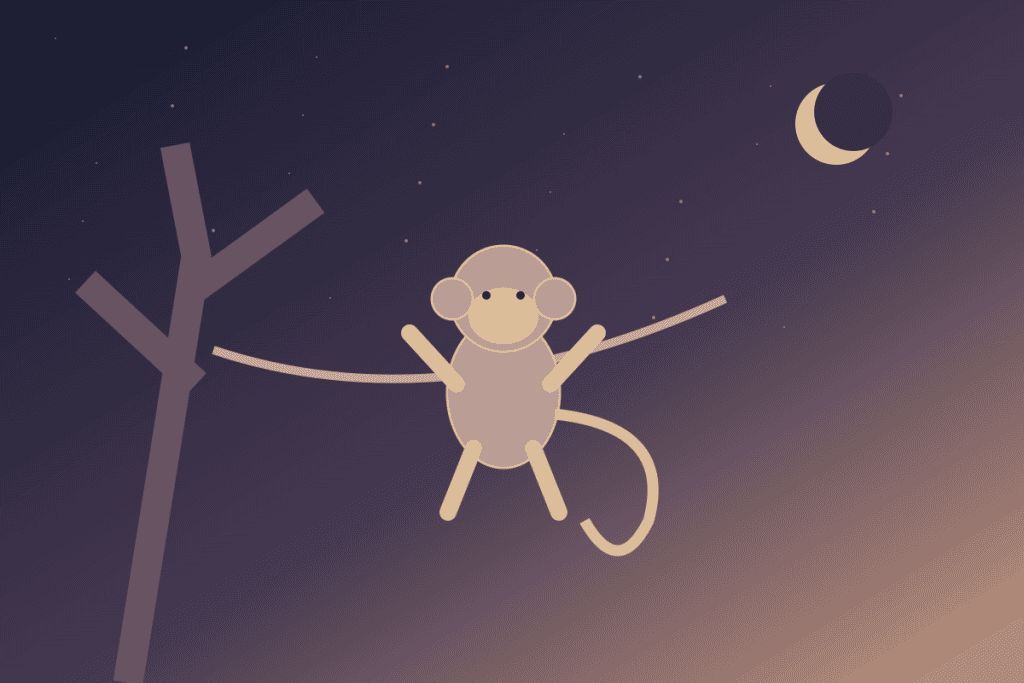
A monkey dream becomes easier to explore when you describe what the animal does. Watching you, copying a gesture and taking your bag create different stories. Your response matters too: delight, irritation and fear do not point to the same personal questions. The dream does not establish that somebody is dishonest, and the animal need not stand for a real person at all.
Start with a verb
Try “it interrupted me”, “it watched from a tree” or “I tried to carry it”. These sentences preserve your role better than a broad label such as mischief. An animal can be amusing while you are resting and frustrating when you are trying to finish something. That difference is worth keeping.
Memories can enter dreams (1). A wildlife programme, a zoo visit or a childhood story offers an ordinary association. Recognising one does not prove why you dreamed it. It gives you an alternative to assuming every vivid animal reveals a hidden conflict.
Play and imitation
If the monkey copies you, notice the audience. Are people laughing with you, looking away or not present at all? You might reflect on being watched or repeating a routine, if that fits your experience. The scene does not diagnose conformity or prove that anyone is mocking you.
If you enjoy the play, let that feeling remain part of the account. You do not have to find a threat underneath a pleasant scene. If the game becomes unwelcome, ask when the change happens and whether you can signal a limit. The question may be about the transition, not about being a playful or serious person.
When it takes something
A monkey moving your papers may interrupt a task. One taking food creates another problem. What are you trying to recover, and what can you no longer do without it? Avoid turning the missing object into a prediction of theft.
If a shoe disappears and prevents departure, compare shoe dreams. If unwanted access to your home is central, burglary dreams examine boundaries. These links are comparisons between scenes, not evidence that their symbols mean the same thing.
Chasing, contact and shelter
Record the distance before calling the dream an attack. Does the animal approach, follow or actually make contact? Can you step back, close a door or reach another person? A question about pressure may be useful if it fits your waking life, but the dreamed animal does not identify an enemy.
If you remember a bite, the aftermath may matter more than physical detail. Do you ask for help, receive it or discover the scene has changed? There is no need to decode each body part. A dreamed injury is not a medical assessment or a prediction of bodily harm.
One animal, a group or an enclosure
A small monkey may feel endearing or intrusive. A group may be interesting to watch or difficult to keep track of. Neither size nor number supplies a fixed meaning. Describe whether you have a task, are responsible for the animals or simply pass through the scene.
An enclosure introduces separation. Perhaps it reassures you; perhaps you want to open it. Do not assume it must represent lost freedom. Your feeling about the barrier is a better starting point than a standard positive or negative label.
A question you can test
Fictional example: somebody enjoys a monkey rearranging their notes until an important page disappears. They might reflect on how a welcome distraction becomes an unwanted interruption. Another dreamer might mainly recognise a film scene. Neither interpretation is compulsory.
Write the remembered action, the feeling and a possible connection on separate lines. “It moved my notes” is the scene; “I felt rushed” is the emotion; “perhaps I want fewer interruptions” remains a hypothesis. Reject it if it does not fit. A useful reading should clarify your experience rather than create suspicion about another person.
Sources
(1) Vallat et al. (2017), Characteristics of the memory sources of dreamshttps://journals.plos.org/plosone/article?id=10.1371/journal.pone.0185262
Personal symbolic readings; the cited studies do not validate universal meanings.
Further reading
 Cheating dream meaning: being unfaithful or being cheated on
 Bear dream meaning: calm bears, pursuit, cubs and protection
 Dreaming of mice: hiding, many mice, catching and caring for one
 Burglary dream meaning: intruders, a searched home and missing things
 Dreaming of rats: bites, infestations, dead rats and pets
 Money dream meaning: finding, receiving, losing and giving
 Dreaming about a wedding: getting married, missed vows and cancellations
 Flood dream meaning: rising water, flooded homes and finding safety